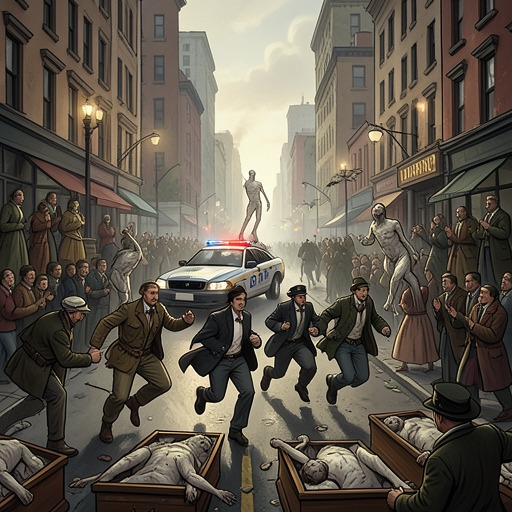
The Stockholm Woodland Cemetery grave-search operation
Handling the UndeadThe Stockholm Woodland Cemetery grave-search operation is the first reported, large-scale encounter between the military and the returned dead. What begins as an examination of graves becomes a scene of attempted escape, physical restraint, and mounting confusion. Its newspaper accounts make the cemetery both a crisis site and a threshold in public understanding: the dead are no longer safely contained by burial, and familiar definitions of death can no longer be taken for granted.
Background and Scope
The operation was part of a wider response to the mass return of people who had been declared dead or buried. At Stockholm Woodland Cemetery, the military began examining at least 200 graves. The report places the first discovery at half past one in the morning, and describes the work as an urgent undertaking rather than a controlled medical investigation. Other coffins were being dug up without first being opened, while military personnel filled the cemetery.
The scale implied by the operation extended beyond this single cemetery. The report said the remaining graves there were scheduled to be opened that day, with work then continuing at the other eighteen city cemeteries. An accompanying editorial placed the local emergency within an unprecedented national event, claiming that two thousand Swedes, whether declared dead or already buried, had returned to life. The grave search was therefore not simply an attempt to recover particular bodies; it was an effort to confront a phenomenon that had outgrown ordinary procedures for burial and the declaration of death.
The First Grave and the Enclosure
The first person uncovered was an 87-year-old man who had been dead for six weeks. His body was in an advanced state of decomposition, but he was alive and tried to flee from the cadets opening his grave. Flesh peeled away when touched. Soldiers used the burial shroud to force him to the ground, and two people were required to hold him. The report’s blunt contrast between severe physical decay and continued life makes the operation’s central fact difficult to assimilate: the body bears the marks of burial, yet its movement demands an immediate response.
The military began constructing an enclosure to restrain the dead. Colonel Johan Stenberg called the fence a temporary measure and said there was no alternative. The enclosure was finished at half past two. Meanwhile, soldiers continued opening graves, and the dead attempted to find their way out: fumbling and uncertain, many tried to evade the military before being brought back. The fence offered a provisional boundary, not a resolution. It could contain bodies in the cemetery, but it could not restore the distinction between a grave as a place of rest and a grave as a place from which someone might escape.
Strain on the People at the Cemetery
The operation’s psychological pressure appears alongside its physical danger. Behind the enclosure, fifteen of the dead stood pressed against the fence, their empty eye sockets facing outward. A cadet sat apathetically nearby, then threw himself onto the ground and covered his ears. Stenberg attributed the young man’s reaction to psychological pressure, but the report suggested that the colonel’s words did not convey what he truly felt. The scene exposes the cost of treating the dead as a practical containment problem: the personnel assigned to manage the crisis are themselves confronted with something they cannot readily absorb.
The account also records quarrels in several quarters and fights that commanding officers had to break up. Three more bodies had been dug up before ambulances arrived; no hospital transports had been visible earlier. By the time the newspaper was preparing its report, the situation had been reduced to chaos. A few of the dead might have escaped, and nearby residents were urged to keep their doors locked. The threat thus spread beyond the enclosure: even an uncertain possibility of escape was enough to make the surrounding neighborhood part of the emergency.
Public Meaning and Aftermath
The newspaper coverage pairs the scene report with an editorial that asks whether death can still be regarded as final. Its answer is that it probably cannot. The editorial does not settle the cause of the returns, but proposes that, if religious or paranormal explanations are set aside, the body may possess a biological mechanism capable of restarting metabolism. It stresses that research is not definitive, even as it argues that the available indications challenge established assumptions.
That challenge reaches beyond medical explanation. The editorial says that none of the classic signs of death remain valid and that there is no longer a reliable way to declare someone dead: everyone may come back. It invokes cryogenics, noting that wealthy people—particularly in the United States—had arranged for their bodies to be frozen after death. In this new context, the image of bodies resting in such a state becomes more than a technological curiosity; it belongs to a world in which burial no longer guarantees an ending.
The operation’s significance lies in the collision between that public question and the cemetery’s immediate, practical disorder. Soldiers need to restrain the dead, protect nearby residents, and continue examining graves, while the newspaper’s editorial confronts the collapse of death as a dependable category. Neither the fence nor the report can make the returned people fit the old boundaries. The grave search records the moment when burial ceases to be a conclusive answer and becomes the beginning of another emergency.